Kea DHCP
Database Support
Carsten Strotmann and the ISC Kea Team
Created: 2025-11-13 Thu 10:59
In this Chapter
- Database backends for Kea
- Database setup and maintenance
- Host/Reservation Data in the database
Database backend support for Kea
Why a database backend?
- The Kea DHCP server can store in a database:
- Lease information
- Host addresses and prefixes
- Host options
- Host names
- Host classification
- Configuration
Benefits of using a database backend
- Faster turn-around for configuration changes in large deployments (many DHCP servers)
- Easy access to DHCP information from scripts
- Option to build a custom management interface for the DHCP service
- High-Availability through database redundancy
- Easier to integrate into existing backup systems
Drawbacks of using a database backend
- when issuing a lease, Kea DHCP must wait for the storage backend to
acknowledge the successful storage of lease information
- depending on the database setup and implementation, this is often slower then the Kea in-memory (lease-file) storage
- Some databases cannot store lease information that reaches beyond the year 2038
PostgreSQL
- powerful, open source object-relational database system
- flexible and extensible
- performance is in par with commercial database offerings on Linux/Unix
- PostgreSQL License (permissive open source license)
- PostgreSQL: https://www.postgresql.org
MySQL/MariaDB
- MySQL is the most popular (network based) open source SQL database
system
- MariaDB is a compatible fork of MySQL by the original MySQL development team
- MySQL/MariaDB is available in most Linux/Unix systems
- MySQL and MariaDB are GPLv2 licensed
- MariaDB https://mariadb.com
- MySQL https://www.mysql.com
Database setup
Preparing the database
- steps required before Kea can connect to a database system:
- create the database
- create a user for Kea in the database system
- set the access permissions on the Kea database
PostgreSQL (1/2)
- Most PostgreSQL installations come with a dedicated operating
system user account for the PostgreSQL database (in our examples,
the user
postgres).- all database configuration steps should be done as this database user
PostgreSQL (2/2)
- Creating the database for storing Kea lease information and giving
the user
keaaccess permissions on this database
(kea-server)# su - postgres
(kea-server)$ psql -U postgres
Password for user postgres:
psql (12.4)
Type "help" for help.
postgres=# CREATE USER kea WITH PASSWORD 'secure-password';
CREATE ROLE
postgres=# CREATE DATABASE kea_lease_db;
CREATE DATABASE
# GRANT ALL PRIVILEGES ON DATABASE kea_lease_db TO kea;
postgres=# \q
Preparing a MariaDB/MySQL database (1/2)
- To prepare the MySQL/MariaDB database for Kea, first the database are created (in this example, one database for leases)
mysql -u root -p
Enter password:
Welcome to the MariaDB monitor.  Commands end with ; or \g.
Your MariaDB connection id is 8
Server version: 10.4.14-MariaDB MariaDB Server

Copyright (c) 2000, 2018, Oracle, MariaDB Corporation Ab and others.

Type 'help;' or '\h' for help. Type '\c' to clear the current input statement.

MariaDB [(none)]> CREATE DATABASE kea_lease_db;
Query OK, 1 row affected (0.000 sec)
Preparing a MariaDB/MySQL database (2/2)
- In the next step, the database user
keais created and given access to the lease-database:
MariaDB [(none)]> CREATE USER 'kea'@'localhost' IDENTIFIED BY 'secure-password';
Query OK, 0 rows affected (0.006 sec)

MariaDB [(none)]> GRANT ALL ON kea_lease_db.* TO 'kea'@'localhost';
Query OK, 0 rows affected (0.005 sec)

MariaDB [(none)]> quit
Bye
MySQL performance tuning
- If MySQL is used with the InnoDB database backend (the default),
changing the MySQL internal value
innodb_flush_log_at_trx_commitfrom default value1to2can result with huge gain in Kea performanceIt can be set per session for testing:
mysql> SET GLOBAL innodb_flush_log_at_trx_commit=2;
mysql> SHOW SESSION VARIABLES LIKE 'innodb_flush_log%';
or permanently in
/etc/mysql/my.cnf[mysqld] innodb_flush_log_at_trx_commit=2
Changing this value can create problems during data recovery after a database crash - please check the MySQL documentation.
Maintaining the Kea-Database with kea-admin
Initializing the Kea database (1/2)
- The command
db-initof thekea-admintool is used to initialize the database- while it is possible to initialize the SQL databases with the
SQL-scripts provided with Kea, it is recommended to use the
kea-admintool, as it provides extra security checks in the process
- while it is possible to initialize the SQL databases with the
SQL-scripts provided with Kea, it is recommended to use the
- Example: initializing a PostgreSQL database for lease database
# kea-admin db-init pgsql -u kea -h 127.0.0.1 -p secure-password -n kea_lease_db
Checking if there is a database initialized already. Please ignore errors.
Initializing database using script /opt/kea/share/kea/scripts/pgsql/dhcpdb_create.pgsql
psql:/opt/kea/share/kea/scripts/pgsql/dhcpdb_create.pgsql:142: NOTICE:  function lease4dumpheader() does not exist, skipping
psql:/opt/kea/share/kea/scripts/pgsql/dhcpdb_create.pgsql:150: NOTICE:  function lease4dumpdata() does not exist, skipping
psql:/opt/kea/share/kea/scripts/pgsql/dhcpdb_create.pgsql:180: NOTICE:  function lease6dumpheader() does not exist, skipping
psql:/opt/kea/share/kea/scripts/pgsql/dhcpdb_create.pgsql:188: NOTICE:  function lease6dumpdata() does not exist, skipping
psql:/opt/kea/share/kea/scripts/pgsql/dhcpdb_create.pgsql:892: WARNING:  there is already a transaction in progress
Database version reported after initialization: 6.1
Initializing the Kea database (2/2)
- Example: initializing a MySQL/MariaDB database for leases
# kea-admin db-init mysql -u kea -p secure-password -n kea_lease_db
Checking if there is a database initialized already. Please ignore errors.
Verifying create permissions for kea
MySQL Version is: 10.4.14-MariaDB
Initializing database using script /opt/kea/share/kea/scripts/mysql/dhcpdb_create.mysql
mysql returned status code 0
Database version reported after initialization: 9.3
Upgrade of database schema (1/3)
- Sometimes a new Kea version may require a new database schema
- The existing database will need to be upgraded
- After upgrade, it may be impossible to subsequently downgrade to an earlier version
- Before upgrading, please make sure that the database is backed up
- The
kea-admin db-upgradecommand can be used to upgrade an existing database
Upgrade of database schema (2/3)
To check the current version of the database, use the following command (
<db-product>can bemysqlorpgsql):$ kea-admin db-version <db-product> -u <db-user> -p <db-password> -n <db-name>
- If the version does not match the minimum required for the new version of Kea (as described in the release notes), the database needs to be upgraded.
- see also Databases and Database Version Numbers https://kea.readthedocs.io/en/latest/arm/admin.html#kea-database-version
Upgrade of database schema (3/3)
- The
kea-admincommand is used to upgrade the database schema of the database (<db-product>can bemysqlorpgsql):
$ kea-admin db-upgrade <db-product> -u database-user -p database-password -n database-name
Kea Database Configuration
Configuration Example: Lease Database in PostgreSQL
Example of a lease database configuration in Kea (file
kea-dhcp4.conforkea-dhcp6.conf)- for MySQL/MariaDB, just change the
typetomysql
"lease-database": { "type": "postgresql", "name": "kea_lease_db", "user": "kea", "password": "secure-password", "host": "localhost" },- for MySQL/MariaDB, just change the
Test the configuration
# kea-dhcp4 -t /opt/kea/etc/kea/kea-dhcp4.conf

2020-10-22 11:43:23.772 INFO  [kea-dhcp4.hosts/61595.139911418369920]
           HOSTS_BACKENDS_REGISTERED the following host backend types are available: mysql
2020-10-22 11:43:23.773 INFO  [kea-dhcp4.dhcpsrv/61595.139911418369920]
           DHCPSRV_CFGMGR_SOCKET_TYPE_DEFAULT "dhcp-socket-type" not specified , using default socket type raw
2020-10-22 11:43:23.774 INFO  [kea-dhcp4.dhcpsrv/61595.139911418369920]
           DHCPSRV_CFGMGR_NEW_SUBNET4 a new subnet has been added to configuration: 192.0.2.0/24 with params: t1=900, t2=1800, valid-lifetime=3600
Host/Reservation in a SQL Database
Host/Reservation in a SQL Database - Why?
- Larger deployments might want to change the DHCP reservations
dynamically and programatically via the API
- The Host Commands hook adds a number of new commands to Kea used to query and manipulate host reservations
- see Chapter 3 of this training for a discussion of the Host-Commands API
- the Host Commands hook requires a database for storing the host reservations
- If reservations are specified in both file and database, file reservations take precedence over the ones in the database
Creating a PostgreSQL database to store host reservations
- Creating the database for storing Kea host information
(reservations) and giving the user
keaaccess permissions on this database
(kea-server)# su - postgres
(kea-server)$ psql -U postgres
Password for user postgres:
psql (12.4)
Type "help" for help.

postgres=#  CREATE DATABASE kea_host_db;
CREATE DATABASE
postgres=# GRANT ALL PRIVILEGES ON DATABASE kea_host_db TO kea;
GRANT
postgres=# \q
Initializing the Host reservation database
- The command
db-initof thekea-admintool is used to initialized the database- while it is possible to initialize the SQL databases with the
SQL-scripts provided with Kea, it is recommended to use the
kea-admintool, as it provides extra security checks in the process
- while it is possible to initialize the SQL databases with the
SQL-scripts provided with Kea, it is recommended to use the
- Example: initializing a PostgreSQL database for use as a host reservation database
# kea-admin db-init pgsql -u kea -h 127.0.0.1 -p secure-password -n kea_host_db
Checking if there is a database initialized already. Please ignore errors.
Initializing database using script /opt/kea/share/kea/scripts/pgsql/dhcpdb_create.pgsql
psql:/opt/kea/share/kea/scripts/pgsql/dhcpdb_create.pgsql:142: NOTICE:  function lease4dumpheader() does not exist, skipping
psql:/opt/kea/share/kea/scripts/pgsql/dhcpdb_create.pgsql:150: NOTICE:  function lease4dumpdata() does not exist, skipping
psql:/opt/kea/share/kea/scripts/pgsql/dhcpdb_create.pgsql:180: NOTICE:  function lease6dumpheader() does not exist, skipping
psql:/opt/kea/share/kea/scripts/pgsql/dhcpdb_create.pgsql:188: NOTICE:  function lease6dumpdata() does not exist, skipping
psql:/opt/kea/share/kea/scripts/pgsql/dhcpdb_create.pgsql:892: WARNING:  there is already a transaction in progress
Database version reported after initialization: 6.1
Configuration Example: Host Database in PostgreSQL
Host database for PostgreSQL configuration in Kea (file
kea-dhcp4.conforkea-dhcp6.conf)- for MySQL/MariaDB, just change the
typetomysql
"hosts-database": { "type": "postgresql", "name": "kea_host_db", "user": "kea", "password": "secure-password", "host": "localhost" },- for MySQL/MariaDB, just change the
Using Read-Only Databases with Host Reservations
- the host reservation information might be stored in a database that contains other (sensitive) inventory information for the network
- in some cases, for policy and security reasons, the Kea DHCP server
should not be able to write into this database
read-only access for retrieving reservations for clients and/or assigning specific addresses and options, can be configured explicitly in Kea with the read-only mode
"Dhcp4": {
  "hosts-database": {
      "readonly": true,
      ...
  },
  ...
}
Kea Configuration Database Backend
Storing Kea configuration in a database
- The Kea DHCPv4 and DHCPv6 servers support loading their configuration from an database
- The configuration back end supports
- subnet and shared-network configurations
- global DHCPv4/DHCPv6 parameter
- option definitions
- global, network and pool options
Benefits of the Kea database configuration backend
- The local Kea configuration on each server can be simple and static
- Each DHCP server can share an almost identical preconfigured configuration
- Enables offline configuration
- Sharing configuration between HA cluster members -> keeping the config in sync
- Helps with automatic configuration management
Kea configuration backend design (1/4)
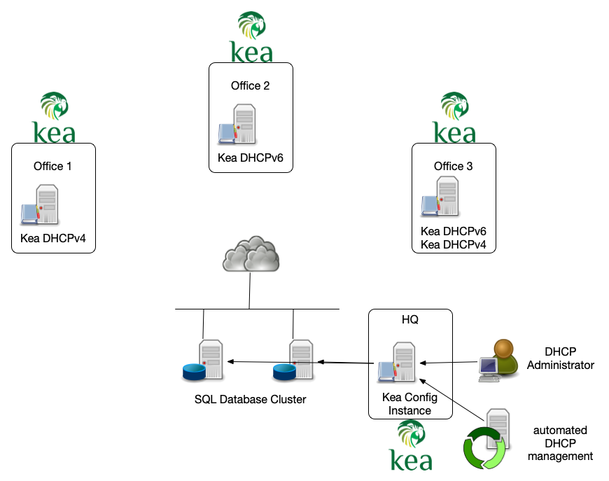
- Administrators apply changes to the configuration into the database via the Kea Configuration Backend Commands hook
- it is also possible to directly access the configuration on the SQL database level
- changing the configuration on the database level requires a good understanding of the configuration database schema
- the Kea configuration command hook provides essential business logic that ensures logical integrity of the data
Kea configuration backend design (2/4)
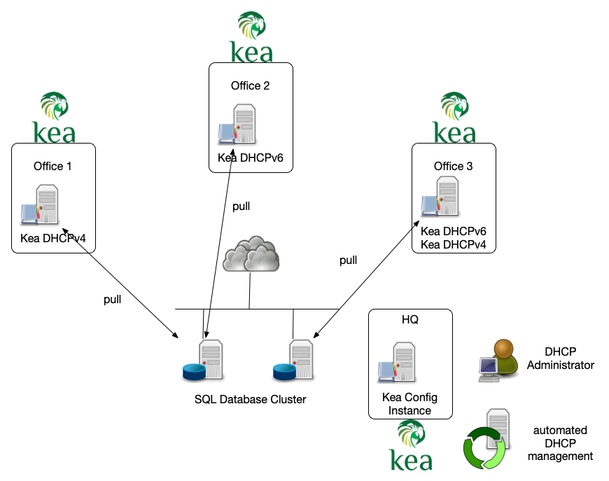
- Kea DHCP server will pull/poll the configuration from the database
- the poll interval is configured with the
config-fetch-wait-timeparameter - if a change is detected, the Kea DHCP server will fetch the delta to its current configuration and will reconfigure the service
- the poll interval is configured with the
Kea Configuration Backend Design (3/4)
Kea Configuration Backend Design (4/4)
Basic configuration for a Kea DHCP using the Config Backend
- each DHCP server that uses the Kea configuration backend can run on
a simple and static configuration
- the
server-tagis selecting the individual configuration for this DHCP server config-fetch-wait-timeparameter defines the poll intervall for new configuration (default 30) in seconds
- the
"Dhcp6": {
   "server-tag": "office-1",
   "config-control": {
     "config-databases": [{
        "type": "mysql",
        "name": "kea_config_db",
        "user": "kea",
        "password": "secure-password",
        "host": "2001:db8:568::568"
    }],
    "config-fetch-wait-time": 120
  },
  [...]
}
Hooks required for the config backend
- The hook
libdhcp_mysql_cb.sois the implementation of the Configuration Backend for MySQL. - It must be always present when the server uses MySQL as the
configuration repository.
- this hook is part of the base open source Kea distribution
"hooks-libraries": [{
    "library": "/usr/lib/kea/hooks/libdhcp_mysql_cb.so"
}, {
    "library": "/usr/lib/kea/hooks/libdhcp_cb_cmds.so"
}],
Hooks required for the config backend
- The hook
libdhcp_cb_cmds.sois optional. - It should be loaded when the Kea server instance is to be used for
managing the configuration in the database
- This hooks library is only available to ISC customers with a support contract
"hooks-libraries": [{
    "library": "/usr/lib/kea/hooks/libdhcp_mysql_cb.so"
}, {
    "library": "/usr/lib/kea/hooks/libdhcp_cb_cmds.so"
}],
Objects in the configuration database
- Kea can read the configuration of different DHCP objects from the database
- global parameter
- option definitions
- options
- shared subnet
- subnet
- pools
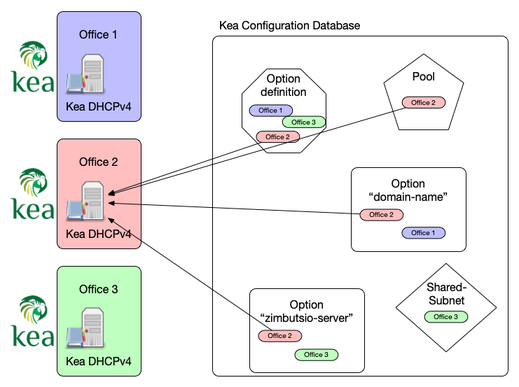
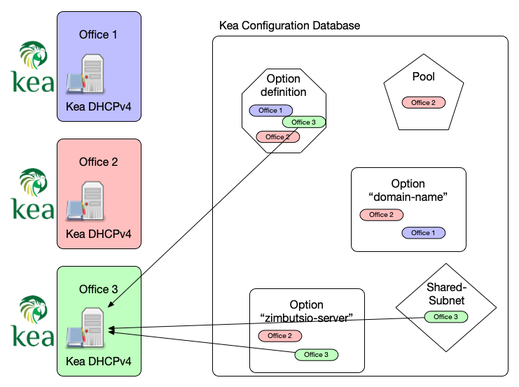
The role of server tags (1/2)
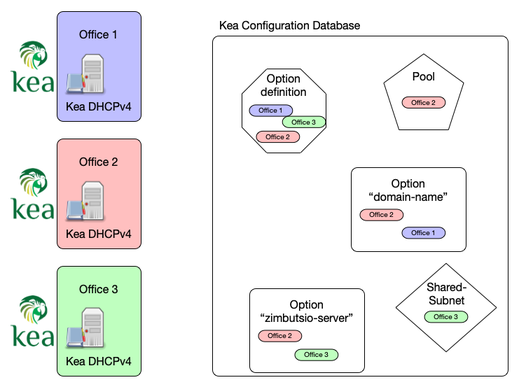
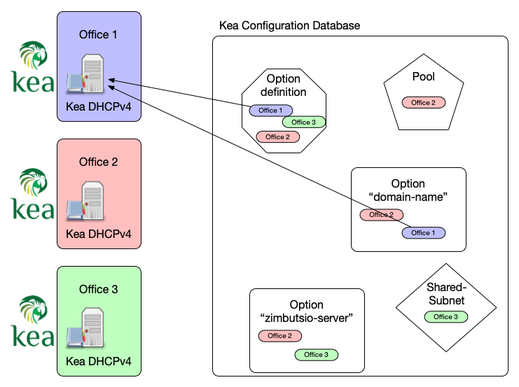
- DHCP server select their configuration objects by the use of server-tags
- each DHCP server has one tag
- multiple servers can share a tag
- a server without an explicit server-tag configuration uses the
special
alltag
The role of server tags (2/2)
- Configuration objects in the database have tags assigned
- objects can reference multiple server tags
- objects can reference no server (empty tag "")
- objects can reference the special tag "all" to reference all DHCP servers
Use of Server-Tags in the configuration backend (1/4)
Use of Server-Tags in the configuration backend (2/4)
Use of Server-Tags in the configuration backend (3/4)
Use of Server-Tags in the configuration backend (4/4)
Configuration Backend Resources
- Kea Reference Manual: Kea Configuration Backend https://kea.readthedocs.io/en/kea-1.8.0/arm/config.html#kea-configuration-backend
- Kea Configuration Backend Design https://gitlab.isc.org/isc-projects/kea/-/wikis/designs/configuration-in-db-design
- Video: Alan Clegg: Using the Kea Configuration Backend https://www.youtube.com/watch?v=gnVEO4ThE10
Recovering from Database failures
Recovering from Database failures (1/3)
- When operating Kea with a database backend, the database or the connection to the database might fail
- During server start-up, the inability to connect to the database is considered fatal and the server will exit
- During dynamic reconfiguration, the databases are disconnected and
then reconnected using the new configuration
- If connectivity to the database(s) cannot be established, the server will log a fatal error but remain up.
- It will be able to process commands but will not serve
clients
- This allows the configuration to be fixed via a remote command, if required
Recovering from Database failures (2/3)
- During normal operations, if connectivity to database is lost and
automatic recovery is enabled …
- … the server will disconnect from all databases
- … and then attempt to reconnect them
- During the recovery process, the server will cease serving clients, but continue to respond to commands
- Once connectivity to all databases is restored, the server will return to normal operations
- If connectivity cannot be restored after
max-reconnect-tries, the server will issue a fatal error and exit
Recovering from Database failures (3/3)
- The parameter
reconnect-wait-timeconfigures number of milliseconds the server will wait between attempts to reconnect to the database after connectivity has been lost- The default value for MySQL and PostgreSQL is
0, which disables automatic recovery and causes the server to exit immediately upon detecting the loss of connectivity to a database
- The default value for MySQL and PostgreSQL is